Lesson 8: Buy Now, Pay Later: What Does It Really Cost?
Year level: Year 10 (middle ability set)Duration: 60 minutesFocal concept/topic: Buy Now, Pay Later: What Does It Really Cost? | |
Lesson aim: Investigate stated BNPL terms and explain how charges change total purchase cost. | |
Learning intention: We are learning to calculate BNPL purchase costs under clearly stated payment conditions. Success criteria: □ I can identify payment amounts, dates and separately stated charges. | |
Syllabus outcomes and content: NSW Education Standards Authority (NESA, 2022).
| Working Mathematically indicators:
|
ICT: Pairs build and audit spreadsheet formulas, then vary an explicitly stated charge to investigate changing totals. One student enters; the other checks against handwritten arithmetic; swap roles. | LIT:
|
Prerequisite knowledge:
| Resources:
Teacher model: Spending_Money_Teacher_Spreadsheet.xlsx, L8 BNPL sheet. A completed formula-and-values snapshot follows below. Students construct their own model before seeing the teacher version. |
Labels used in this plan: WM Working Mathematically LIT Literacy ICT Technology AfL Assessment for learning AoL Assessment of learning
Key teacher question → Expected: suggested student response. Self-designed WM indicators are in italics.
Teaching sequence
| Steps & timing | Teaching & learning activities |
|---|---|
| ORIENTATION0–8 minRetrieval and bridge | Teacher: Review a common Lesson 7 error without naming students. Use Task 8A.
|
| ENHANCING8–18 minWorked schedule | Teacher: Model Task 8B using Day 0, 14, 28, 42. Read all conditions before computing.
|
| ENHANCING18–23 minHinge and response | Use Task 8C independently.
|
| ENHANCING23–40 minICT investigation | Teacher: Give Task 8D. Demonstrate input headings, not completed answers.
|
| ENHANCING40–50 minCritical comparison | Students: Answer Task 8E individually, then discuss in pairs.
|
| SYNTHESIZING50–55 minExplain and revise | Students: Correct “Offer B is interest-free so its total is always the cash price.”
|
| SYNTHESIZING55–60 minIndependent exit | Students: Complete Task 8F; no partner or spreadsheet help, calculator allowed. AoL End-of-lesson individual mastery record against the success criteria. Mark the exit task out of 4 using the criteria below; this records attainment after instruction. AfL Sort errors into payment count, omitted charge and interpretation; use them for Lesson 9 retrieval. Contingency: Reduce sharing, preserve exit. |
Worked solutions
8A: A $400 item is paid in four equal payments, including one today, with no charges. Each = $100; total = 4 × $100 = $400, not $500.
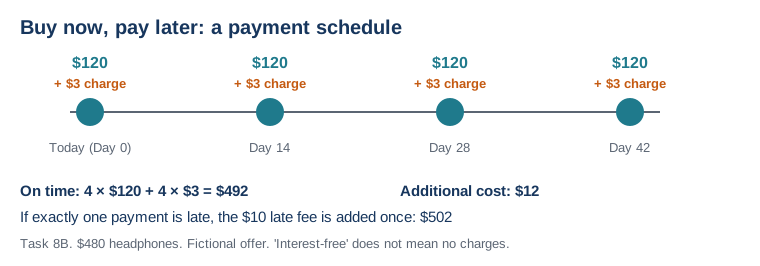
8B: $480 headphones. Four payments of $120 on Days 0, 14, 28 and 42. A separate $3 account charge is paid at each scheduled payment date. If exactly one payment is late, an additional $10 charge applies once. On time: 4 × 120 + 4 × 3 = $492; additional cost $12. Specified late case: $492 + $10 = $502; additional cost $22. The $10 does not replace the late $120 payment.
8C Hinge: $300 item; three payments of $100, including today; $2 charge at each date; no late fee in this scenario. A $300, B $302, C $306, D $406. Correct C = 3 × 100 + 3 × 2. Fresh check: $200 item, four $50 payments with $1 charge each → $204.
8D: $640 tablet. Cash $640. Offer A: four $160 payments including today, no account charge, $8 per late payment. Offer B: eight $80 payments including today, $14 account charge in total, $15 per late payment. Calculate on-time total and total with exactly one late payment.
| Option | On time | One late payment | Additional cost: on time / late |
|---|---|---|---|
| Cash | $640 | Not applicable | $0 / not applicable |
| A | $640 | $648 | $0 / $8 |
| B | $654 | $669 | $14 / $29 |
Student-built spreadsheet: choose a clear layout with columns for Offer, Payment amount, Payment count, Total account charges, Fee per late payment, Late-payment count and Total paid. The completed teacher file uses inputs in rows 6 and 7: G6 = B6*C6+D6+E6*F6, copied to G7. Set F6 and F7 to 1 for one late payment. Increase E6 to $12 with F6 = 1: total $652; with F6 = 0 it remains $640. Account charges in D are totals. Students may use other row positions if their references remain consistent.
8E: Both offers require the first scheduled payment today; remaining A payments are fortnightly, remaining B payments weekly. Fictional buyer can pay no more than $100 today and $90 at each later date; B’s $14 account charge is payable separately with its first payment. Which fits these limits? B: $94 today and $80 later. A fails: $160 today and later. Cash fails today: $640. A is cheaper on time by $14. These ceilings alone do not establish affordability or credit eligibility. Ask what income timing and other commitments are missing.
8F Exit: $360 item; six payments of $60, including today; separate $2 charge at each date; one additional $9 fee for exactly one late payment. On time = $360 + $12 = $372. Specified late case = $381. Explain “interest-free means no additional cost”: false in this offer; charges add $12 or $21.
Exit assessment criteria
Task 8F: on-time total $372 with payment and charge count shown (1); one-late total $381 (1); interest-free does not mean fee-free (1); cites $12 or $21 additional charges under the correct scenario (1). AoL records four criteria separately. Use the same evidence formatively to decide next-lesson feedback. A correct total without an explanation does not demonstrate the reasoning criterion.
Completed teacher spreadsheet example
File: Spending_Money_Teacher_Spreadsheet.xlsx, L8 BNPL. Offer inputs follow Task 8D. Columns A–F are editable; G calculates total paid. Row 6 contains A, 160, 4, 0, 8, 0; row 7 contains B, 80, 8, 14, 15, 0. G6 = B6*C6+D6+E6*F6; G7 uses the same pattern. On-time outputs: $640 and $654. Set late-payment counts to 1: $648 and $669. Set A late fee to $12 with one late payment: $652. A separate comparison block displays both on-time and one-late totals without changing the input scenario.
Adjustments and anticipated misconceptions
| Barrier / misconception | Specific support and retained demand |
|---|---|
| Adds payment today twice | Mark today as payment 1 of the stated total number. |
| Omits charges / repeats total charge | Underline whether a charge is per payment or a total; place it in the appropriate column. |
| Spreadsheet difficulty | Give headings and cell locations; retain student-built formula and handwritten check. |
| EAL/D / reluctant speaker | Annotate short terms and use “Under the __ scenario, total cost is __ because …”. |
| Extension | For B on-time to equal A with one late payment, A’s late fee must be $14; justify 640+f=654. |
Vocabulary
| Term | Student-friendly definition |
|---|---|
| BNPL | A payment arrangement that divides a purchase into scheduled payments. |
| Interest-free | No interest is charged under the stated conditions; other charges may still apply. |
| Account charge | A separately stated charge for the payment arrangement. |
| Late fee | An additional charge when a specified payment is late. |
| Payment schedule | The dates and amounts of required payments. |
| Conditional total | Total for a stated scenario, such as exactly one late payment. |
Sources acknowledged in this lesson
NSW Education Standards Authority. (2022). Mathematics K–10 syllabus: Stage 5, Financial mathematics A. https://curriculum.nsw.edu.au/learning-areas/mathematics/mathematics-k-10-2022/content/stage-5/facb3aa952
Syllabus content and outcome descriptions above reproduce NESA wording; italicised lesson WM indicators are teacher-designed applications.
All offer terms are fictional classroom data, not current financial-product or legal information. Each lesson totals 60 minutes. Support should respond to observed student work, and all learners retain the core calculation and reasoning goals.