Lesson 7: Paying for a Purchase Over Time
Year level: Year 10 (middle ability set)Duration: 60 minutesFocal concept/topic: Paying for a Purchase Over Time | |
Lesson aim: Calculate complete payment-plan costs and distinguish total cost from payment manageability. | |
Learning intention: We are learning to calculate and compare the complete cost of purchases paid over time. Success criteria: □ I can calculate a percentage deposit and the number and total of repayments. | |
Syllabus outcomes and content: NSW Education Standards Authority (NESA, 2022).
| Working Mathematically indicators:
|
ICT: Calculator use supports arithmetic only. | LIT:
|
Prerequisite knowledge:
Students have studied earning money and simple interest in the proposed sequence, but this lesson does not require a loan-interest formula. | Resources:
|
Labels used in this plan: WM Working Mathematically LIT Literacy ICT Technology AfL Assessment for learning AoL Assessment of learning
Key teacher question → Expected: suggested student response. Self-designed WM indicators are in italics.
Teaching sequence
| Steps & timing | Teaching & learning activities |
|---|---|
| ORIENTATION0–6 minContext and retrieval | Teacher: Present a fictional $900 purchase. Reveal LI/SC and inquiry: “Can a smaller monthly repayment cost more overall?” Use Task 7A, including the Lesson 6 simple-interest bridge. Allocate 2 minutes to the interest check, 2 minutes to deposit/payment retrieval and 2 minutes to purpose and feedback. Students: Independently calculate 20% of $900 and payments per year. AfL Simultaneous responses; refresh percentage conversion or months only where needed. |
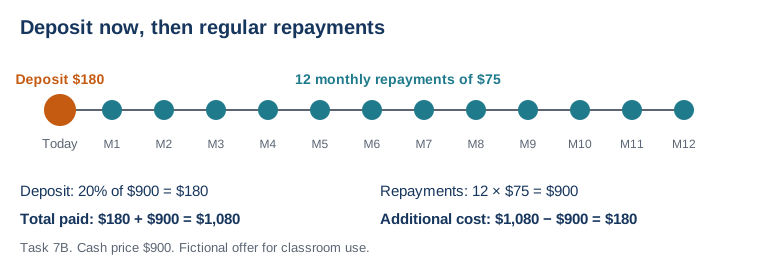
| ENHANCING6–18 minExplicit model | Teacher: Model Task 7B with separate deposit, repayments and total rows. Draw: deposit now → 12 monthly payments.
|
| ENHANCING18–21 minHinge check | Teacher: Display Task 7C; collect individual A–D answers simultaneously.
|
| ENHANCING21–26 minResponsive teaching | Teacher: Reteach the dominant hinge error on a timeline, or use Task 7D as a partially worked transfer if secure.
|
| ENHANCING26–43 minMain comparison | Teacher: Give Task 7E. Students calculate both plans individually before partner comparison. Then reveal buyer limits.
|
| ENHANCING43–48 minAdvertising prompt | Teacher: Display “Laptop from $65 a month”.
|
| SYNTHESIZING48–55 minConsolidation | Students: Rehearse an evidence-based explanation with a partner; revise an anonymous claim: “B is cheaper because $65 is less than $105.”
|
| SYNTHESIZING55–60 minIndependent exit | Students: Complete Task 7F without partner help. AoL End-of-lesson individual mastery record against the success criteria. Mark the exit task out of 4 using the criteria below; this records attainment after instruction. AfL Collect calculations and explanations. Next lesson, respond to deposit, payment-count or comparison errors separately. Contingency: Shorten public sharing if needed; retain independent exit evidence. |
Worked solutions
7A Retrieval: Find 20% of $900; how many monthly payments are in one year? Answers: 0.20 × 900 = $180; 12 payments. Lesson 6 bridge: $900 at 5% p.a. simple interest for one year gives I = 900 × 0.05 × 1 = $45 and $945 altogether. Ask: “Is this $45 calculated in the same way as the $180 additional purchase cost?” Expected: no; the simple-interest task uses a stated rate and time, while the purchase-plan cost comes from deposit plus repayments minus cash price. No interest rate is given in the purchase plan.
7B Model: Cash price $900; 20% deposit followed by $75 monthly for 12 months; no other charges. Deposit = $180. Repayments = 12 × $75 = $900. Total paid = $180 + $900 = $1,080. Additional cost = $1,080 − $900 = $180.
7C Hinge: Cash price $1,000; 20% deposit followed by $90 monthly for one year. A $1,280; B $1,080; C $1,190; D $290. Correct A: $200 + 12 × $90 = $1,280. B omits deposit; C uses 11 payments; D uses one payment.
7D Fresh check: Cash price $800; 10% deposit then $70 monthly for 12 months. Deposit $80; repayments $840; total $920; additional cost $120. Ask: “What must be added to $840?” Expected: the one-off $80 deposit.
7E Comparison: Cash price $1,200. Plan A: 20% deposit then $105 monthly for 12 months. Plan B: 10% deposit then $65 monthly for 24 months. Neither has other charges.
| Quantity | Plan A | Plan B |
|---|---|---|
| Deposit | $240 | $120 |
| Repayment total | $1,260 | $1,560 |
| Total paid | $1,500 | $1,680 |
| Additional cost | $300 | $480 |
Buyer statement: “I can pay no more than $150 upfront and $80 per month.” Questions: Which costs less overall? Which fits both limits? Does this prove affordability? Answers: A costs $180 less; only B fits both limits; no — income, essential expenses, other commitments and unexpected costs are unknown. Delaying or not buying is defensible. Extension: Find B’s monthly payment for equal total cost: 120 + 24m = 1,500, so m = $57.50.
7F Exit: Tablet cash price $600. X: 10% deposit plus $55 monthly for 12 months. Y: $120 deposit plus $95 monthly for 6 months. Calculate X’s deposit and total; compare. X: $60 + $660 = $720. Y: $120 + $570 = $690. Y costs $30 less despite its larger monthly repayment.
Exit assessment criteria
Task 7F: deposit $60 (1); correct payment count and repayment total $660 (1); total $720 (1); Y is $30 cheaper using both totals (1). AoL records four criteria separately. Use the same evidence formatively to decide next-lesson feedback. A correct total without an explanation does not demonstrate the reasoning criterion.
Adjustments and anticipated misconceptions
| Barrier / misconception | Specific support and retained demand |
|---|---|
| Percentage confusion | Use 10% as one tenth, then build 20%; retain the same deposit calculation. |
| Omitting deposit / miscounting payments | Provide separately labelled rows and a timeline; require payment count before multiplication. |
| Language / participation barriers | Offer vocabulary, sentence frame and partner rehearsal; every student still writes their own comparison. |
| Early finisher | Use the equal-total monthly-payment extension; require equation and interpretation. |
Observation checklist: Record Complete calculation / Evidence-based comparison / Careful interpretation for each student as I (independent), P (prompted) or N (not yet). Partner observations show process; the individual exit is the stronger transfer evidence.
Vocabulary
| Term | Student-friendly definition |
|---|---|
| Cash price | Price paid for the item outright. |
| Deposit | Initial amount paid before the later repayments. |
| Instalment / repayment | One scheduled payment. |
| Duration | How long the payment plan lasts. |
| Repayment total | Sum of the scheduled repayments, excluding the initial deposit in these offers. |
| Total paid | Deposit plus all repayments and any separately stated charges. |
| Additional cost | Total paid minus cash price. |
| Affordability | Whether a person can meet payments while covering other needs and commitments. |
Sources acknowledged in this lesson
NSW Education Standards Authority. (2022). Mathematics K–10 syllabus: Stage 5, Financial mathematics A. https://curriculum.nsw.edu.au/learning-areas/mathematics/mathematics-k-10-2022/content/stage-5/facb3aa952
Syllabus content and outcome descriptions above reproduce NESA wording; italicised lesson WM indicators are teacher-designed applications.
Adapted from Georgia Wang’s Assignment 1, Appendix 1: Paying for a Purchase Over Time. Original numerical model, hinge, main comparison and exit ticket are retained. Explicit curriculum, literacy and assessment labels, vocabulary definitions and the transfer-check solution have been added.
All offer terms are fictional classroom data, not current financial-product or legal information. Each lesson totals 60 minutes. Support should respond to observed student work, and all learners retain the core calculation and reasoning goals.